Welcome to Country Kids on the Fly - Fly Tying Page. Here you will find fly tying instructions for trout, steelhead, salmon, bass, carp, and other warmwater fly patterns. This page will be updated weekly, so check back regulary for new patterns. If you do not see a fly pattern you would like to tie, and would like me to put the pattern on this page, or if you have any questions about the fly patterns regarding tying, fishing, etc., please email me at countrykidsonthefly@gmail.com.
All the flies featured in this Fly Tying page are avaiable custom tied from Autumn Siren Flies.
Showing posts with label streamer. Show all posts

Sunday, December 9, 2012

Conehead Marabou Muddler


The marabou muddler is one of my favorite general purpose fly pattern. Last spring Art and myself did well using the yellow version for smallmouth, carp, and northern pike on the Allegheny Reservoir, trout on the Kinzua Tailwater, and Chadakoin River carp all summer long. Tied with a light cone, the buoyant deer hair gives this fly a slow sink that is perfect for cruising carp.  I split this pattern into two steps, the body and the head since you must change from the 6/0 you use for the body to the heavier stuff you use to spin the deer hair.

Hook: MFC no. 7008 size 8 or a Daiichi 2220 size 6-10
Weight: gold colored brass conehead
Body
Thread: 6/0
Tail: red schlappen fibers
Body: silver braid
Wing: yellow marabou
Flash: pearl krystal
Head
Spun Deer Hair or Cow Elk

The Body

STEP 1:  Take a MFC no. 7008 size 8 or a Daiichi 2220, flatten the barb, and slip on a appropriately sized gold colored brass conehead.  Attach your 6/0 black thread behind the conehead and wrap back to the tie in point.


Take a large clump of red schlappen feather fibers and tie them in so they extend 1/2 the length of the hook shank past the tie in point.


STEP 2: At the tie in point tie in a length of silver braid.  Advance your thread 2/3 the way up the shank.

 
Wind the silver braid up 2/3 the way up the hook shank.  Secure with the thread and trim off the excess.


STEP 3:  Take a plum of yellow marabou, remove the center stem, and tie in so the marabou extends the same length as the red schlappen does.  Tim off the excess and secure several wraps of thread.


STEP 4:  Tie in 3 strands of pearl krystal flash onto either side of the marabou.  Trim so they are the same length as the marabou.  Whip finish and trim off the 6/0 thread.


Tie up several bodies before tieing the deer hair heads.

The Deer Hair

STEP 5: Take your 3/0, "G", "GX2", or other heavy thread between the marabou and the conehead.  Color choice is up to you.


STEP 6: Cut a piece of deer hair from the hide approx. the size of a pencil.  Stack the hair in a hair stacker so the tips are all the same length.  Spin the deer hair so the tips form a collar around the marabou.  Do not the tips or butts of the hair.


STEP 7: Push the deer butts back and build a thread dam in front of the deer hair so the butts stick straight up at 90 degree angles from the shank. 


STEP 8:  Cut a second clump of deer hair, cut off the tips, and remove the underfur. Take the clump and spin in front of the deer hair collar.  Whip finish and tie off.

Tie several deer hair heads before trimming.

STEP 9:  Take your hair scissors and trim the deer hair butts so they form a head the same diameter as the cone.  DO NOT TRIM THE TIPS!!!


The Finished Fly


Monday, November 12, 2012

Ice Dub Bugger


The Ice Dub Bugger is a simple woolly bugger pattern for steelhead.  Slightly different to fool our educated steelhead, fish this fly just as you would a regular woolly bugger. Dead drift or swing.

Hook: MFC no. 7099 size 8-10
Thread: 3/0
Weight: beadhead (optional)
Tail: marabou
Body: Ice Dub
Hackle: schlappen
Colors: black, olive, white, purple

STEP 1: Take a MFC no. 7099 size 8 and place it in your vise.  Take your thread and use a jam knot to attach your thread to the hook shank.  Wrap back to the tie in point.


STEP 2: Select a large marabou plum and remove the stiff center stem. Measure the feather against the hook shank, the marabou should extend past the tie in point the same length as the shank. Tie in the marabou using a pinch wrap and bind down the stem. Trim off the excess.


STEP 3: Select a large schlappen feather, remove the fluffly fibeers from the base of the hackle, and tie the feather in at the tie in point.


STEP 4: With your thread hanging down at the tie in point, dub a 2-3in. long section of Ice Dub onto your thread. 

STEP 5: Dub a evenly tapered body with the Ice Dub up to behind the hook eye. (Photo 5A)


Photo 5A
Take a piece of the velcro and use the rough side to roughen up the Ice Dub body. (Photo 5B)

Photo 5B
STEP 6: Palmer the schlappen feather up the hook eye.  Right before you tie off, wind 3 wraps of hackle directly on top of each other to form a collar.  Whip finish and cut the thread.


The Finished Fly

Saturday, November 10, 2012

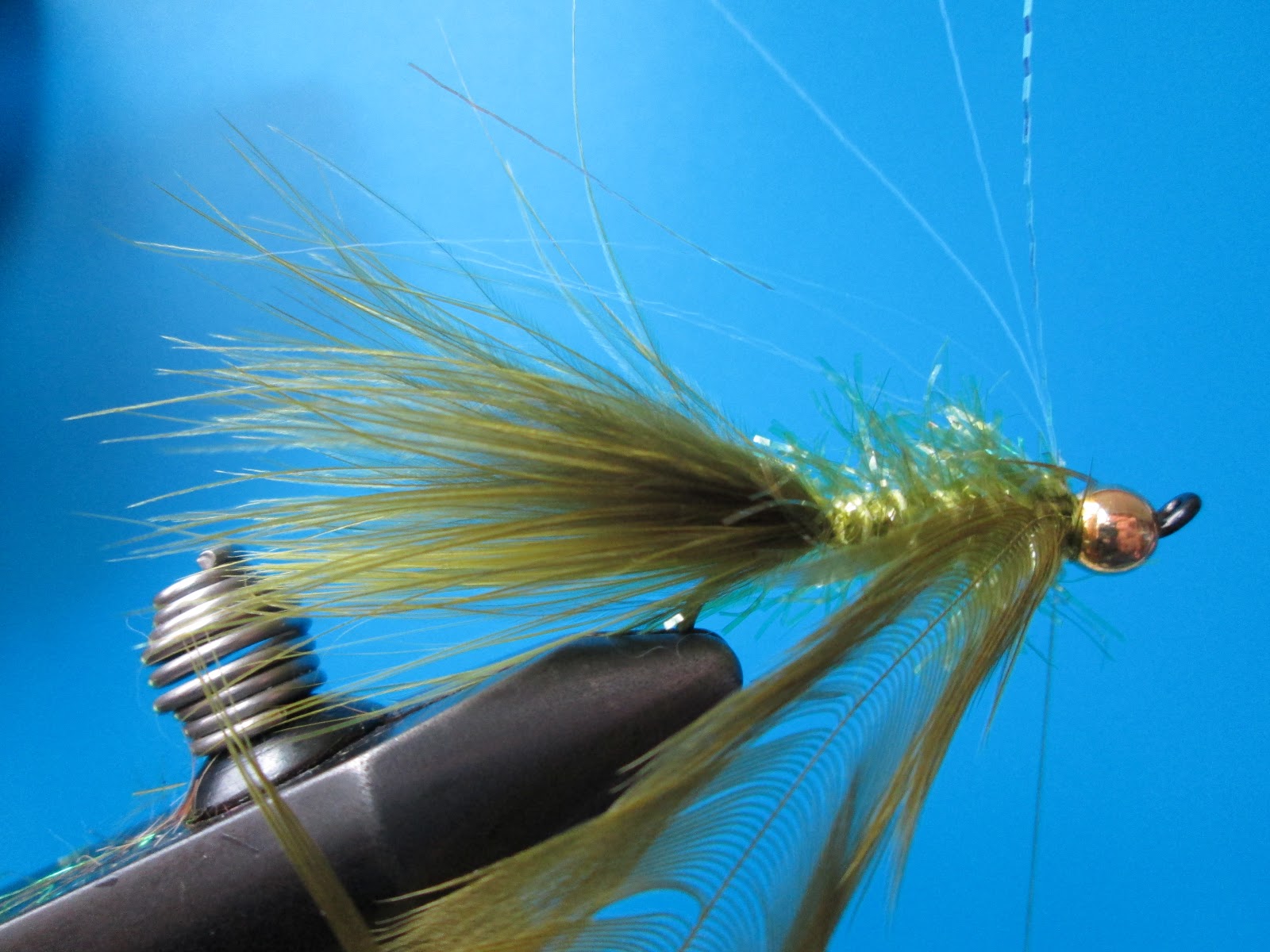
Elk Creek Bugger


 The Elk Creek Bugger is a version of the white woolly buggers that have become popular on Elk Creek.The Elk Creek Bugger is a mix between the Flash Fly and the white Woolly Bugger.  White was the original but chartreuse, black, olive, and blue are also effective colors while swinging for steelhead.

Hook: MFC no. 7099 size 8
Thread: 3/0 color to match fly
Weight: gold beadhead
Tail: marabou
Body: Estaz or cactus chenille
Wing: 6 strands of pearl flashabou
Collar 1#: 2 wraps of olive schlappen
Collar 2#: olive guinea fowl feather
Colors: white, olive, black, chartreuse, blue

STEP 1: Take a MFC no. 7099 size 8, flatten the barb, and slip on a large gold beadhead.  Attach your thread behind the beadhead, build a thread dam to prevent the bead from slipping backwards, and wrap back to the tie in point.


STEP 2: Select a large marabou plum and remove the stiff center stem.  Measure the feather against the hook shank, the marabou should extend past the tie in point the same length as the shank.  Tie in the marabou using a pinch wrap and bind down the stem.  Trim off the excess. (Photo 2A)


Photo 2A

 
At the tie in point, tie in a length of Estaz or cactus chenille. Advance your thread to behind the beadhead.
Photo 2B
STEP 3: Wrap the Estaz or cactus chenille up to the thread behind the beadhead.  Secure and trim off the excess.


STEP 4: Take 4-6 strands of pearl flashabou and tie in on the top of the fly.


STEP 5: Take a Schlappen feather, strip off the fuzzy fibers on the bottom, and tie in by the tip (Photo 5A).
Photo 5A

Wind two wraps of hackle onto the fly.  Be sure to be sparse with this step.  Trim off the excess hackle. (Photo 5B)

Photo 5B

STEP 6: Take a large Guinea Fowl feather that's dyed to match the color of the flies body (available from Spirit River).  Use a natural colored feather (black and white) for a white bodied bugger.  Prepare the feather by stripping off the fuzzy material at the base of the stem and pulling the fibers back.  Tie the feather in by the tip. (Photo 6A)

Photo 6A

Wrap the guinea fowl feather around the shank twice, then secure and trim off.  Whip finish and add a drop of head cement. 


The Finished Fly

Thursday, November 1, 2012

Egg Sucking Leech


The Egg Sucking Leech is a woolly bugger type pattern that is a old standby for fall run steelhead and salmon.  The Egg Sucking Leech is supposed to imitate a leech eating an egg. The  purple/orange combination works particularly well in dirty water. Purple is the last color to be filtered out of water so it is the easiest for the fish to see when visibility is poor (the fish see the outline of the fly). 

Hook: MFC no. 9007 size 6-10
Thread: black 3/0
Weight: leadwire (optional)
Tail: marabou
Body: chenille
Hackle: schlappen
Egg: orange chenille
Colors: black, purple

STEP 1: With your streamer hook of choice in the vise attach your thread mid shank and wrap back to the tie in point.  You may want to add a few wraps of leadwire for weight.


STEP 2: Take a plum of marabou, and remove the stiff tip of the feather.  Measure the marabou against the hook shank, the tail should be the same length as the hook shank.  Tie in the marabou feather at the tie in point.


STEP 3: With your tail tied in, take a length of chenille and a schlappen feather.  Tie the schlappen feather in at the tie in point by the tip.  Strip approx. 1/4 of a inch of the fuzzy part of the chenille off to expose the thread core inside.  Tie in the chenille.  Advance your thread to 1/3in behind the hook eye, leaving enough room for the egg.


STEP 4: Wrap the chenille up to the thread with even wraps.  Tie off with several wraps.


STEP 5:  Wind the schlappen hackle over the chenille to the thread.  The hackle should be evenly spaced up to the thread, then you should make 3 wraps on top of each other.  Tie off and trim of the excess hackle stem.


STEP 6: Now its time to make the egg.  Take a length of orange chenille and prepare it the same way you did for the body.  Tie in the chenille directly in front of were the black body ends.  Advance your thread to behind the hook eye.


STEP 7:  Make a ball of chenille to form the egg. 


The Finished Fly

Sunday, October 14, 2012

Flash Fly


The Flash Fly is a woolly bugger type fly invented by a Pennsylvania steelhead fisherman.  Not to be confused with the Jim Teeny pattern, this fly is good when the water is slightly off color and when the fish can't see a white woolly bugger that well.  Tie some up and try them the next time you go fishing. 

Hook: MFC no. 7008
Thread: white 3/0
Weight: gold beadhead
Tail: white marabou
Body: silver hackle flash

STEP 1:  Flatten the barb on your streamer hook of choice and slide on a gold beadhead (the small hole should be going in the direction of the hook eye). Put the hook in the vise and attach your white thread mid-shank and wrap back to the tie-in-point.


STEP 2: Select a large white marabou feather and remove the center stem.  Tie the marabou feather in so that it extends the same length as the hook shank from the tie in point.  Secure the marabou with many thread wraps and make sure the entire shank is covered. Trim off the excess.


STEP 3: Tie in a length of pearl hackle flash so that the "flash" points backwards.  Advance your thread to behind the beadhead.

STEP 4: Wrap the pearl hackle flash up to your thread.  This fly is most effective when tied sparse so don't overdo it with the flash.  Tie off and whip finish.


The finished fly.
A large inland Brown that ate the Flash Fly.


Tyler Straigh
Custom Tied Steelhead Flies
CKOF Website Design
 countrykidsonthefly@gmail.com

Friday, August 3, 2012

Elk Creek Bugger


The Elk Creek Bugger is a version of the white woolly buggers that have become popular on Elk Creek.  The Elk Creek Bugger is a mix between the Flash Fly and the white Woolly Bugger.

Hook: Daiichi 2441 or MFC 7099bk Size 8
Weight: Gold Beadhead
Thread:  White 6/0
Tail: White Marabou
Body: White Estaz
Wing: Pearl Flashabou
Hackle: White Schlappen and Guinea Fowl
All the flies shown in CKOF Fly Tying are avaiable from Autumn Siren Flies.