Welcome to Country Kids on the Fly - Fly Tying Page. Here you will find fly tying instructions for trout, steelhead, salmon, bass, carp, and other warmwater fly patterns. This page will be updated weekly, so check back regulary for new patterns. If you do not see a fly pattern you would like to tie, and would like me to put the pattern on this page, or if you have any questions about the fly patterns regarding tying, fishing, etc., please email me at countrykidsonthefly@gmail.com.
All the flies featured in this Fly Tying page are avaiable custom tied from Autumn Siren Flies.
Showing posts with label egg. Show all posts

Friday, November 16, 2012

Blood Dot


The Blood Dot is arguably the most popular egg pattern for Great Lakes steelhead.  Invented by PA steelhead fisherman Jeff Blood, the Blood Dot is a highly realistic imitation of a single steelhead egg.  The fly is not named because its characteristic dot is supposed to imitate blood, but because it "Blood's" dot.  This is the original Blood Dot pattern just as Jeff ties them.  This fly has become so popular that almost every fly pattern tied out of Glo-Bug yarn with a dot is called a blood dot.  Most are not blood dots, however  they are tied out of heavily compacted yarn tied in a round ball.  The tightly packed yarn is not a good imitation of the translucent steelhead egg.

Hook: MFC no. 7045 size 10-18
Thread: UTC 6/0, color to match dot or body color.
Body: Glo-Bug Yarn, tied in sucker spawn style. Usually a egg color.
Dot: Glo-Bug Yarn, usually a bright color

STEP 1: With a Montana Fly Company no. 7045 size 10, 12, 14, or 16 in your vise, attach the thread behind the eye with a jam knot and wrap back to just in front of the barb.  Don't go back too far or you will distort the proportions of the entire fly.


STEP 2:  Separate a strand of Glo-Bug yarn into strands the diameter of the hook gap.  For a size 12 hook, you usually get 4-5 strands from the main piece.  Sparseness is the key to this pattern.  Less material means more translucency and more fish.  Tie the strand of Glo-Bug yarn in at the tie in point, and make enough thread wraps so the hook shank is all the color of the thread. 


STEP 3: Advance your thread 3 wraps and form the first egg loop by bringing the yarn forward and tieing down with a pinch wrap.  This loop should be small, about half the size of the hook gap.


STEP 4: Advance your thread another 3 wraps, your thread should be 2/3 the way up the shank from the tie in point now.  Form a second loop that is slightly larger than the first.  Make sure to make this loop messy, push it back over the first loop.


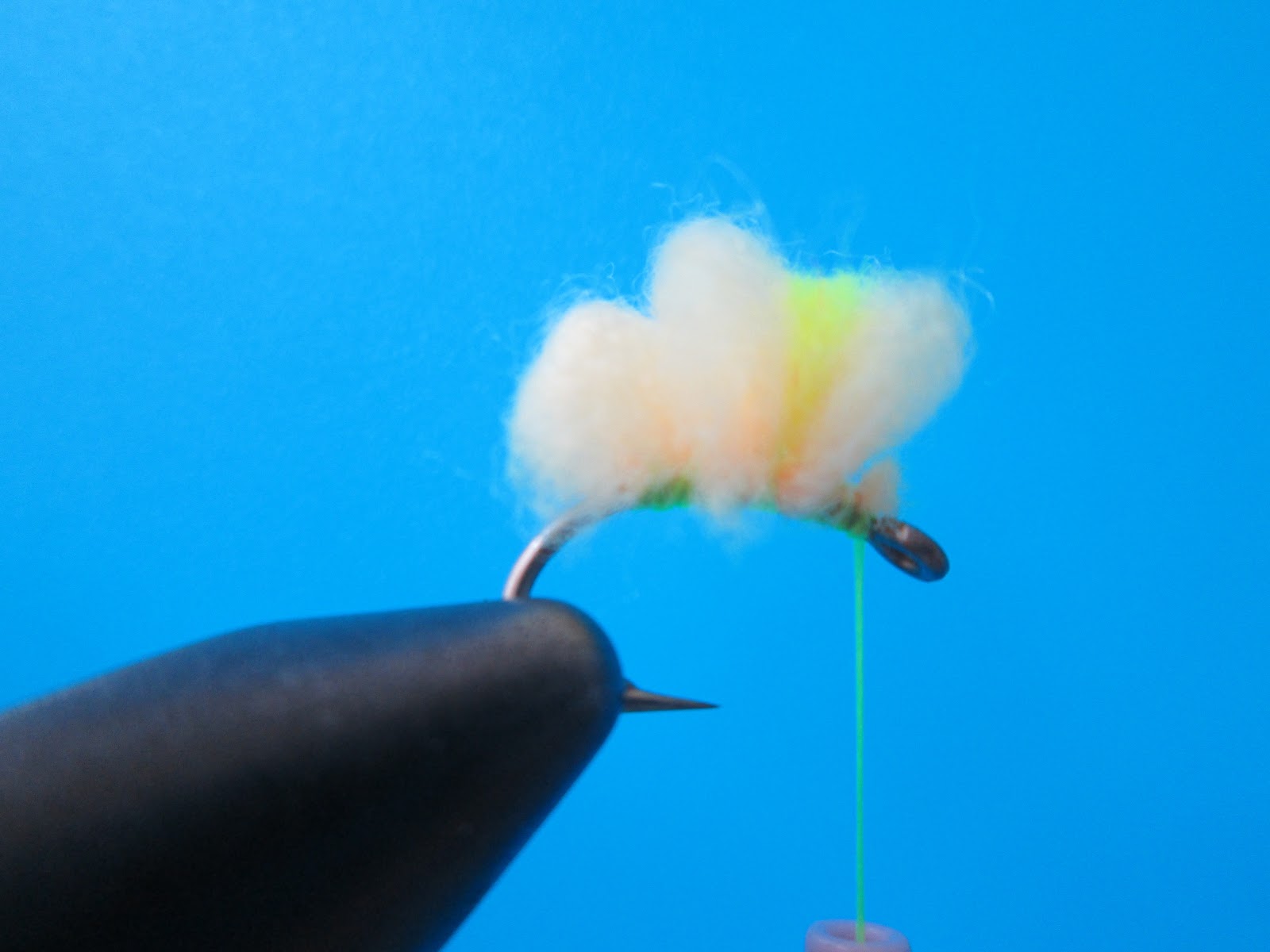
STEP 5: Take another piece of glo bug yarn (a bright color such as orange or chartreuse) and split it into strips that are 1/2 the size of the ones you used earlier.  Less is more with this fly, you need to experiment  to see how much material you need.  Take the yolk/dot material and tie it in in front of the second loop.  Pull both ends up and make a couple of more wraps in front of the yarn.


STEP 6:  Make the last loop directly in front of the dot.  This loop should be the same size to slightly smaller in size than the second loop.  Push the loop back over the dot.  Cut off the excess material tag.


STEP 7: Pull both the ends of the dot material up at the same time and cut the material off at a angle. Whip finish and cut off the thread.


The Finished Fly


I prefer to tie Blood Dots in sizes 12-16 for low water steelhead.  I do sometimes use a size 10 orange/red Blood Dot for dirty water, I prefer to use Estaz Spawn, Crystal Spawn, or Otter's Egg 3x6mm Cluster's steelhead in off-color water.  Steelhead egg are usually a tannish color with a orange or pink tint (I call this egg color).  The embryo inside the egg is usually orange.  The most effective colors for steelhead are egg/orange, egg/pink, egg/chartreuse, egg/cerise, and egg/blue.  For water that's a bit off-color (or a green tint) I like to use a blood dot with a pink, orange, chartreuse, or blue body with a red dot. Another option for tieing is to use Glo-Bug Bling yarn which has pieces of flash embedded in it. 

Egg/Orange
Egg/Pink

Egg/Chartreuse

Egg/Cerise

Jeff Blood ties the Blood Dot


Wednesday, November 7, 2012

Pink Lady Sucker Spawn


 Requested Fly Tutorial 

The Pink Lady Sucker Spawn is just like any other sucker spawn tied with glo bug yarn but this color combination of pink lady and chartreuse has proven extremely effective for steelhead.  This pattern imitates a small cluster of eggs drifting in the current.  This fly does not however imitate sucker eggs (suckers spawn in May) but most likely steelhead or trout eggs.  Because of this flies subdued colors, I like this fly for low water steelhead.  This fly is most effective fished dead drifted in a tandem rig behind a heavier beadhead nymph.

Hook: MFC no. 7045 size12-16
Thread: chartreuse 6/0
Tail: 4 strands of pearl krystal flash
Body: 2 strands of pink lady Glo-Bug Yarn


Pink Lady Glo Bug Yarn is a good color to imitate eggs.  It is a light pink with a chartreuse tint.  Try to use the strands with the more pink color.  You should tie this fly with two strands of yarn when compared to a penny about the diameter of Lincoln's head.  Tie both strands in at once and give each a slight twist (1/2 turn) before forming the loop.  Remember sparse is better.

STEP 1: With your scud hook in your vise, take attach your thread and wrap back to the tie in point.


STEP 2: Take 4 strands of pearl krystal flash and tie them in for the tail.  Trim them so they extend past the tie in point the same length as the hook shank.


STEP 3: Take the two strands of yarn you prepared earlier and tie them in a the tie in point.  Trim off any excess and tie down the butt end with many thread wraps so all you see is chartreuse.


STEP 4: Advance your thread about a 1/8th in.  Take the yarn strands in one hand and bring them forward to the hook eye giving each strand a slight twist.  Form a small loop with the yarn and secure with your thread.


STEP 5: Advance your thread again so it is about 2/3rd the way up the shank.  Take the glo bug yarn again and form a second loop.  Tie down. 


STEP 6: Form a third loop in the yarn to make the last egg.  Secure with thread, build a head and whip finish.  This is a simple fly that should take less than 2 minutes.


The finished fly.


A wet sucker spawn.

Tyler Straight
Custom Tied Steelhead Flies
CKOF Website Design


Saturday, October 13, 2012

Frammus


The Frammus is an egg pattern from the Salmon River.  Its tied differently than most egg patterns but works great for steelhead.  This is also one of my favorite egg patterns for stream trout.  The best color combinations are chartreuse/red and orange.

Hook: MFC no. 7045 size 12-16
Thread: Red, Orange, or Chartreuse 6/0
Body: orange or chartreuse vernille or micro chenille
Wing: Red Glo-Bug Yarn

STEP 1: With your scud hook in the vise, attach your 6/0 thread and wrap back to the tie in point.


STEP 2: Tie in a length of vernille. Make several wraps over the vernille or micro chenille and wrap your thread up to 1/8th in behind the hook eye.


STEP 3: Wrap the vernille or micro chenille up to the thread and tie off with several thread wraps. Trim off the excess.


STEP 4: Take a piece of Glo-Bug yarn and separate it into a strand approx. twice the diameter of the vernille you use.  Tie it in to form a wing that extends to the hook barb.


STEP 5: Fold the strand of Glo-Bug yarn over the wing secure down with several thread wraps.


STEP 6: Cut the top piece of Glo-Bug yarn that was folded back so that it is half the size of the first wing.  Make a couple of half-hitches and cut your thread.

The finished fly.


Tyler Straight
Custom Tied Steelhead Flies
countrykidsonthefly@gmail.com
autumnsirenflies.blogspot.com

Thursday, October 4, 2012

Estaz Grande Spawn


This is a chinook salmon pattern for Oak Orchard. John Trainer of Binghampton, NY showed it to me. It is a simple egg pattern that excels at catching big salmon. 

The Chartreuse caught TONS of fish on the Oak the weekend of Oct. 6. Click Here to Read More


Hook: Daiichi 1120 or MFC 7045 Size 8
Weight: Gold Beadhead
Thread: 3/0 color to match estaz
Body: Estaz Grande
Colors: Pink, Chartreuse, Red, Orange, Blue

STEP 1: Slip a large gold beadhead onto your hook and wrap as many wraps of leadwire as you can fit onto the shank. Put the hook in the vice.


STEP 2: With your hook in the vice, secure your thread behind the beadhead and wrap back to the hook point. Tie in a strand of Estaz Grande.


STEP 3: Wrap your thread back to the beadhead. Put a drop of superglue on the leadwire. Wrap the estaz grande up to your thread (3-4 wraps) whip finish off.


There you have it, a simple fly for Oak Orchard salmon. Tie it in several colors, sizes, and weights (unweighted, beadhead) Make sure you carry 10 + of each color and weight and have at least a dozen pink and chartreuse. Remember, if the fishing is non stop (fish on every cast) you will lose MANY (20+) flies a day. Consider having a reservoir box in your car that contains extra flies in case you run out.

For those going to Oak Orchard on the 21st I still have salmon fly selection on my website autumnsirenflies.blogspot.com.


A good selection of Estaz eggs for salmon.

Tyler Straight
Custom Tied Steelhead Flies
CKOF Website Design

Monday, September 24, 2012

Steel Juan Worm


The Steel Juan Worm is my variation of the popular Orvis steelhead fly the Eggi Juan Kenobi. The Steel Juan Worm is essentially a san juan worm with an egg in front, like a Egg Sucking Leech. Instead of having a glo-bug egg like the Eggi Juan Kenobi, the Steel Juan Worm has a 6mm Otter's Soft Milking Egg.  This is a good steelhead fly for all water conditions, and since it looks different from normal steelhead flies its a good choice for the pressured PA waters.

Hook: MFC no. 7045 size 10
Thread: 6/0 (color to match vernille)
Weight: beadhead (optional)
Body: vernille
Egg: Otter's Soft Milking Egg 6mm
Colors: (vernille/egg) brown/tango, brown/tangerine, red/tango, red/tangerine, pink/tangerine

STEP 1: With a MFC No. 7045 size 10 in your vise, attach your thread and wrap back past the tie-in-point. (Photo 1A)

Photo 1A

Take a 2 1/4in piece of vernille and tie it in so that 3/4in extends past the bend. (Photo 1B)


Photo 1B

STEP 2: Advance your thread to the mid-point between the tie-in-point and hook eye. Be sure to leave enough room for the Otter Egg.  Bring the vernille forward forming a loop, leaving approx. 3/4in sticking forward.

STEP 3: Now take a 6mm Otter Egg (Tango and Tangerine work good) and push it over the eye of the hook. Bring your thread underneath the egg and make several wraps in front to secure the egg.  Whip finish and cut your thread. Your fly is now ready to be fished if you choose not to do the next step.


STEP 4: If you want to you can burn the ends of the vernille with a small lighter. Be careful not to burn to much or burn the egg which will ruin the fly.  Remember this step is completely optional, it only makes the fly look a little nicer to the fisherman and has no affect on the steelhead. Please read my warning below.

***Warning***: Since this is Country KIDS on the Fly I am going to make this statement, if you are a kid DO NOT DO THIS STEP WITHOUT IMMEDIATE PARENTAL SUPERVISION!!! Also do not do this in your fly tying area. Fly tying glues are HIGHLY TOXIC and materials are HIGHLY Flammable. Exercise caution.

Well there you have it, a nice steelhead egg/nymph for steelhead. Try it the next time you head out to the creeks.  If you catch anything email me, I like to here from fisherman.


The finished fly.


Red worm with Tango/Silver Flash egg.
Brown worm with Tango egg.


Red worm with Tango egg.


Tyler Straight
Custom Tied Steelhead Flies
CKOF Website Design

Sunday, August 12, 2012

Estaz Spawn

I invented Estaz Spawn several years ago for steelhead.  Estaz Spawn is tied just like Sucker Spawn except Estaz is used instead of angora or diamond braid.  Estaz is one of my favorite materials for steelhead as it is easy to tie with, bright, and comes in many colors.  Estaz Spawn is my go to fly pattern during all water conditions in steelhead alley.  Pink is the most effective all year long, while Orange works well during low water in the early fall, and Chartreuse produces best in spring.  Were legal (Effective 10/1/12: Multiply flies may now be used on Lake Erie tributaries) I will fish a tandem rig of two different colored Estaz Spawns.  If one color is out producing the other (usually Pink) I will switch to two of the same color.

Hook: Daiichi 1120 or MFC 7045 Size 12
Thread: 6/0 color to match estaz
Body: Estaz
Colors: Pink, Chartreuse, Orange, Red, Blue

STEP 1: Select a Daiichi 1120 Size 12 and place it in your vice.  Attach your thread and wrap back to the tie in point (Picture 1A).  Tie in a length of estaz (Picture 1B).

Picture 1A

Picture 1B

STEP 2: To make the body make 4 small loops, one in front of each. I call this the "sucker spawn method". To make the loops, advance your thread by 2 wraps, bring the estaz forward and tie off (Picture 2A).  Repeat this to form 3 more loops (Picture 2B)

Picture 2A

Picture 2B


STEP 3: Once finished whip finish and trim off your thread.  With practice this fly should take you 1-2 minutes to complete.  It is a simple, effective fly for steelhead and fall/winter trout. 

Finished Estaz Spawn

 Chartreuse Estaz Spawn

From Right to Left: Pink, Chartreuse, Orange, and Blue Estaz Spawn


A fat inland Brown Trout from a local stream.
All the flies shown in CKOF Fly Tying are avaiable from Autumn Siren Flies.