Welcome to Country Kids on the Fly - Fly Tying Page. Here you will find fly tying instructions for trout, steelhead, salmon, bass, carp, and other warmwater fly patterns. This page will be updated weekly, so check back regulary for new patterns. If you do not see a fly pattern you would like to tie, and would like me to put the pattern on this page, or if you have any questions about the fly patterns regarding tying, fishing, etc., please email me at countrykidsonthefly@gmail.com.
All the flies featured in this Fly Tying page are avaiable custom tied from Autumn Siren Flies.
Showing posts with label fall trout. Show all posts

Friday, November 16, 2012

Blood Dot


The Blood Dot is arguably the most popular egg pattern for Great Lakes steelhead.  Invented by PA steelhead fisherman Jeff Blood, the Blood Dot is a highly realistic imitation of a single steelhead egg.  The fly is not named because its characteristic dot is supposed to imitate blood, but because it "Blood's" dot.  This is the original Blood Dot pattern just as Jeff ties them.  This fly has become so popular that almost every fly pattern tied out of Glo-Bug yarn with a dot is called a blood dot.  Most are not blood dots, however  they are tied out of heavily compacted yarn tied in a round ball.  The tightly packed yarn is not a good imitation of the translucent steelhead egg.

Hook: MFC no. 7045 size 10-18
Thread: UTC 6/0, color to match dot or body color.
Body: Glo-Bug Yarn, tied in sucker spawn style. Usually a egg color.
Dot: Glo-Bug Yarn, usually a bright color

STEP 1: With a Montana Fly Company no. 7045 size 10, 12, 14, or 16 in your vise, attach the thread behind the eye with a jam knot and wrap back to just in front of the barb.  Don't go back too far or you will distort the proportions of the entire fly.


STEP 2:  Separate a strand of Glo-Bug yarn into strands the diameter of the hook gap.  For a size 12 hook, you usually get 4-5 strands from the main piece.  Sparseness is the key to this pattern.  Less material means more translucency and more fish.  Tie the strand of Glo-Bug yarn in at the tie in point, and make enough thread wraps so the hook shank is all the color of the thread. 


STEP 3: Advance your thread 3 wraps and form the first egg loop by bringing the yarn forward and tieing down with a pinch wrap.  This loop should be small, about half the size of the hook gap.


STEP 4: Advance your thread another 3 wraps, your thread should be 2/3 the way up the shank from the tie in point now.  Form a second loop that is slightly larger than the first.  Make sure to make this loop messy, push it back over the first loop.


STEP 5: Take another piece of glo bug yarn (a bright color such as orange or chartreuse) and split it into strips that are 1/2 the size of the ones you used earlier.  Less is more with this fly, you need to experiment  to see how much material you need.  Take the yolk/dot material and tie it in in front of the second loop.  Pull both ends up and make a couple of more wraps in front of the yarn.


STEP 6:  Make the last loop directly in front of the dot.  This loop should be the same size to slightly smaller in size than the second loop.  Push the loop back over the dot.  Cut off the excess material tag.


STEP 7: Pull both the ends of the dot material up at the same time and cut the material off at a angle. Whip finish and cut off the thread.
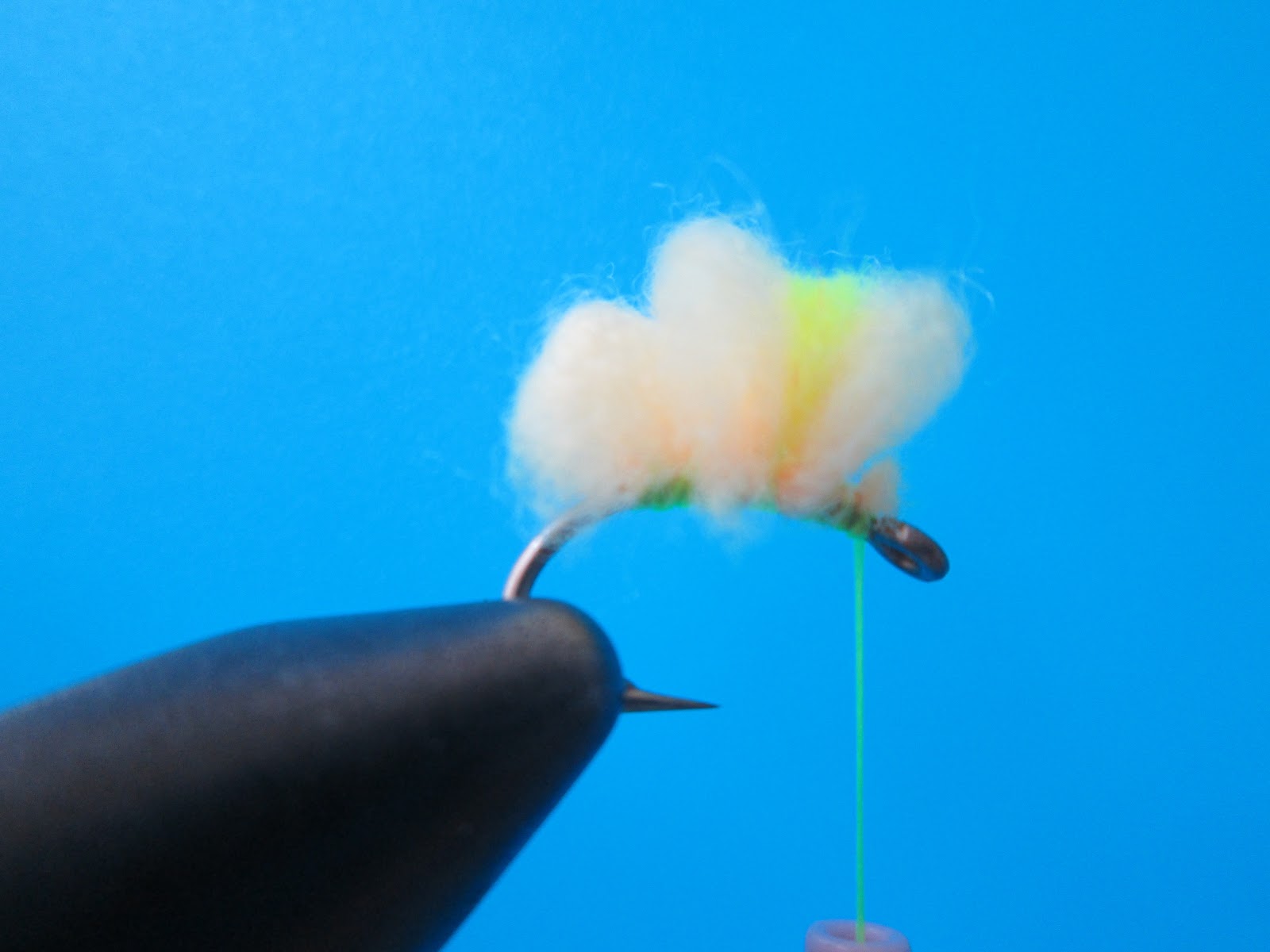


The Finished Fly


I prefer to tie Blood Dots in sizes 12-16 for low water steelhead.  I do sometimes use a size 10 orange/red Blood Dot for dirty water, I prefer to use Estaz Spawn, Crystal Spawn, or Otter's Egg 3x6mm Cluster's steelhead in off-color water.  Steelhead egg are usually a tannish color with a orange or pink tint (I call this egg color).  The embryo inside the egg is usually orange.  The most effective colors for steelhead are egg/orange, egg/pink, egg/chartreuse, egg/cerise, and egg/blue.  For water that's a bit off-color (or a green tint) I like to use a blood dot with a pink, orange, chartreuse, or blue body with a red dot. Another option for tieing is to use Glo-Bug Bling yarn which has pieces of flash embedded in it. 

Egg/Orange
Egg/Pink

Egg/Chartreuse

Egg/Cerise

Jeff Blood ties the Blood Dot


Sunday, November 11, 2012

Easy Finn Raccoon Leach


Easy Finn Raccoon Leech is a real easy, fast and simple egg sucking leech fly for steelhead, trout, and smallmouth.  This fly is tied with Finn Raccoon hair which has great movement in the water. The key to the effectiveness is sparseness, don't use a lot of material.  The egg on this fly is a 8mm Otter's Milking Egg but you can use a Trout Bead if you wish. Orange is the most effective color but you can experiment with pink or chartreuse. You can tie this fly can be tied in an endless number of color combinations.  Tie some up for your next steelhead trip

Hook: MFC no. 7008 size 8-10
Thread: black or olive 6/0
Tail: Ice Dub
Wing: Finn-Raccoon Hair
Egg: size 8 hook - Otter's Soft Milking Egg 8mm or Trout Bead
         size 10 hook - Otter's Soft Milking Egg 6mm or Trout Bead
Color Combinations: (Ice Dub/Finn Raccoon) Chartreuse/Black, Pink/Black, All Black, blue/olive, olive/black.

STEP 1: Take a Montana Fly Company no. 7008 size 8 streamer hook and place it in your vise.  Take your 6/0 black thread, attach mid-shank and wrap back to the tie in point.  While tieing this fly, try not to get any of the black thread where the egg will go, it will show through the translucent Otter Egg.


STEP 2: Select a clump of Ice Dub and tie in a sparse clump mid shank. Tie the clump in so there is an equal amount of material on either side of the wraps.  


STEP 3:  Wet your fingers and comb the Ice Dub back to the rear of the hook.  Make a couple of wraps over the spot where the dub was tied in to keep the Ice Dub in position.  Advance your thread half way between the dub and the hook eye.


STEP 4:  Tie in a sparse clump of black or olive Finn Raccoon hair. Push the hair around the shank with your fingers so all 360 degrees of the fly are covered.  DO NOT trim the butts, they will be used to form a collar.


STEP 5:  Push the butts of the Finn Raccoon back and secure with several thread wraps to form a collar. Be sure to leave enough room for the egg.  Whip Finish and cut the thread.


STEP 6: Place a drop of Loctite Super Glue Gel on the hook shank.


STEP 7: Push your Otter Egg of choice over the drop of super glue.  Hold the egg in place for several seconds until the glue dries.

The Finished Fly
 
All the flies shown in CKOF Fly Tying are avaiable from Autumn Siren Flies.