Welcome to Country Kids on the Fly - Fly Tying Page. Here you will find fly tying instructions for trout, steelhead, salmon, bass, carp, and other warmwater fly patterns. This page will be updated weekly, so check back regulary for new patterns. If you do not see a fly pattern you would like to tie, and would like me to put the pattern on this page, or if you have any questions about the fly patterns regarding tying, fishing, etc., please email me at countrykidsonthefly@gmail.com.
All the flies featured in this Fly Tying page are avaiable custom tied from Autumn Siren Flies.
Showing posts with label spring steelhead. Show all posts

Friday, November 16, 2012

Blood Dot


The Blood Dot is arguably the most popular egg pattern for Great Lakes steelhead.  Invented by PA steelhead fisherman Jeff Blood, the Blood Dot is a highly realistic imitation of a single steelhead egg.  The fly is not named because its characteristic dot is supposed to imitate blood, but because it "Blood's" dot.  This is the original Blood Dot pattern just as Jeff ties them.  This fly has become so popular that almost every fly pattern tied out of Glo-Bug yarn with a dot is called a blood dot.  Most are not blood dots, however  they are tied out of heavily compacted yarn tied in a round ball.  The tightly packed yarn is not a good imitation of the translucent steelhead egg.

Hook: MFC no. 7045 size 10-18
Thread: UTC 6/0, color to match dot or body color.
Body: Glo-Bug Yarn, tied in sucker spawn style. Usually a egg color.
Dot: Glo-Bug Yarn, usually a bright color

STEP 1: With a Montana Fly Company no. 7045 size 10, 12, 14, or 16 in your vise, attach the thread behind the eye with a jam knot and wrap back to just in front of the barb.  Don't go back too far or you will distort the proportions of the entire fly.


STEP 2:  Separate a strand of Glo-Bug yarn into strands the diameter of the hook gap.  For a size 12 hook, you usually get 4-5 strands from the main piece.  Sparseness is the key to this pattern.  Less material means more translucency and more fish.  Tie the strand of Glo-Bug yarn in at the tie in point, and make enough thread wraps so the hook shank is all the color of the thread. 


STEP 3: Advance your thread 3 wraps and form the first egg loop by bringing the yarn forward and tieing down with a pinch wrap.  This loop should be small, about half the size of the hook gap.


STEP 4: Advance your thread another 3 wraps, your thread should be 2/3 the way up the shank from the tie in point now.  Form a second loop that is slightly larger than the first.  Make sure to make this loop messy, push it back over the first loop.


STEP 5: Take another piece of glo bug yarn (a bright color such as orange or chartreuse) and split it into strips that are 1/2 the size of the ones you used earlier.  Less is more with this fly, you need to experiment  to see how much material you need.  Take the yolk/dot material and tie it in in front of the second loop.  Pull both ends up and make a couple of more wraps in front of the yarn.


STEP 6:  Make the last loop directly in front of the dot.  This loop should be the same size to slightly smaller in size than the second loop.  Push the loop back over the dot.  Cut off the excess material tag.


STEP 7: Pull both the ends of the dot material up at the same time and cut the material off at a angle. Whip finish and cut off the thread.
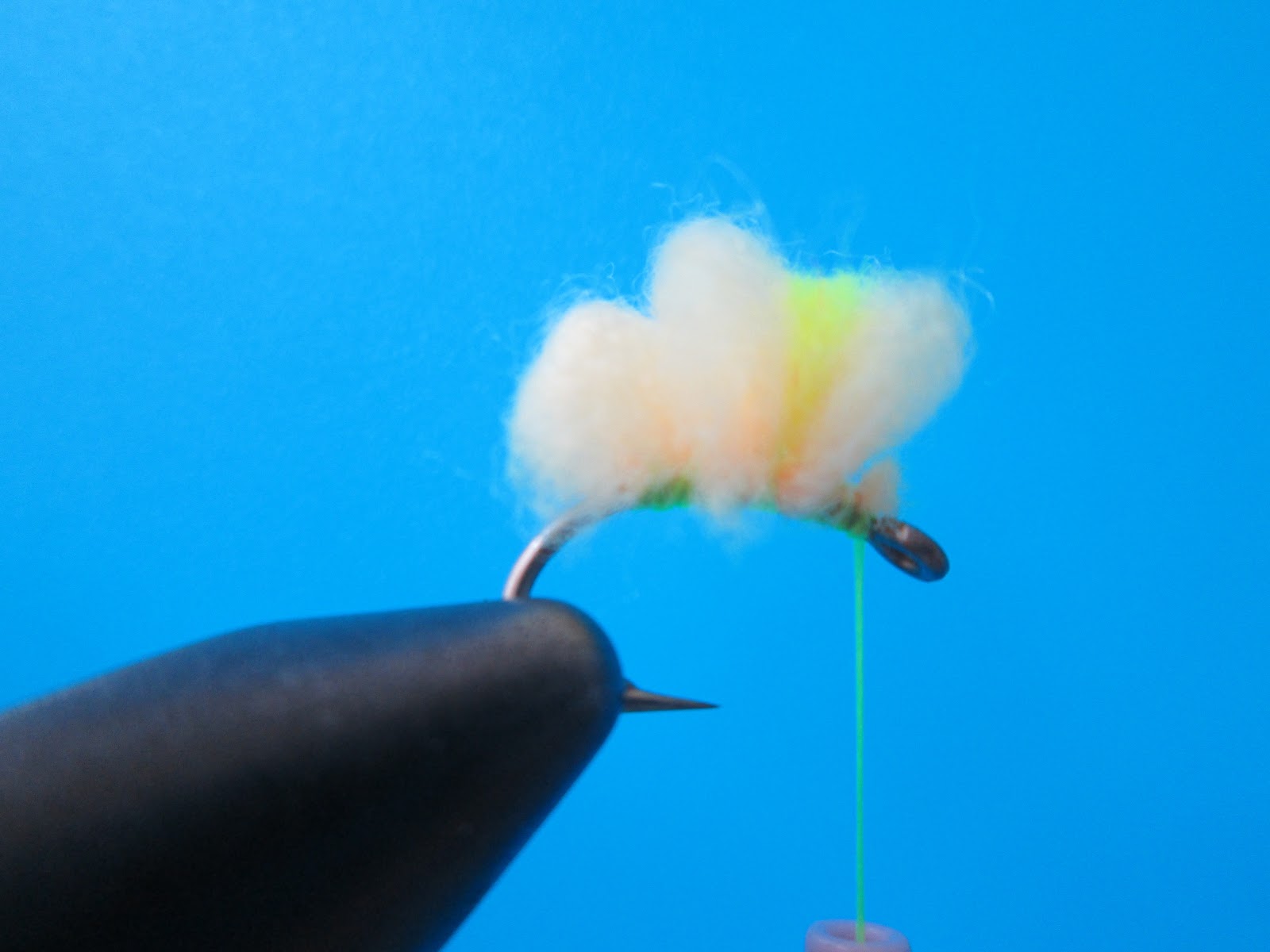


The Finished Fly


I prefer to tie Blood Dots in sizes 12-16 for low water steelhead.  I do sometimes use a size 10 orange/red Blood Dot for dirty water, I prefer to use Estaz Spawn, Crystal Spawn, or Otter's Egg 3x6mm Cluster's steelhead in off-color water.  Steelhead egg are usually a tannish color with a orange or pink tint (I call this egg color).  The embryo inside the egg is usually orange.  The most effective colors for steelhead are egg/orange, egg/pink, egg/chartreuse, egg/cerise, and egg/blue.  For water that's a bit off-color (or a green tint) I like to use a blood dot with a pink, orange, chartreuse, or blue body with a red dot. Another option for tieing is to use Glo-Bug Bling yarn which has pieces of flash embedded in it. 

Egg/Orange
Egg/Pink

Egg/Chartreuse

Egg/Cerise

Jeff Blood ties the Blood Dot


Thursday, October 11, 2012

Art's Golden Stone


Art's Golden Stone is a variation of the Kauffman Golden Stone.  Art Estus showed me a easier technique for tieing the wingcase.  Instead of turkey sections he uses folded scud back.  The golden stonefly is smaller than its cousin the black stonefly and is present in the Lake Erie tributaries. This fly is heavily weighted so it makes a good point fly in a tandem fly rig.

Hook: MFC 7073 size 10-8
Thread: yellow 6/0
Weight: gold beadhead
Tail: yellow goose biots
Antennae: yellow goose biots
Body: yellow hares ear dub
Rib: medium gold wire
Wingcase: 1/4th in wide brown scud back

STEP 1: With a MFC 7073 size 8-10 in your vise, attach your thread near the eye.  Take two yellow goose biots and tie them in for the antennae using the least amount as thread as possible.  The biots should be about the length of half the hook shank.  Whip finish and cut the thread.  I like t tie several fly antennae first then tie the bodies.

Photo 1A
Photo 1B

STEP 2: Slip a gold beadhead onto the hook and push the beadhead over the thread wraps and up to the hook eye.  Take your yellow 6/0 thread attach it mid shank and wrap back to the tie in point.


Photo 2B
Photo 2B
STEP 3: Take another pair of yellow goose biots and tie them in as the tail, they should extend half the hook shank.  Tie in a piece of medium copper wire and bring your thread back to the tie in point. 

Photo 3A


Photo 3B
STEP 4: Take a clump of yellow hares ear dubbing and dub a body so that the dubbing covers the entire first half of the hook shank.  Take the copper wire and rib the dub body.  Trim off the copper wire.


Photo 4A
Photo 4B
STEP 5: Tie in a piece of 1/4th wide brown scud back for the wing case.  Fold over the scud back to form a loop. Secure with several wraps.  Dub a small ball of yellow hares ear dub other the thread wraps.


Photo 5A
Photo 5B

STEP 6: Fold a another loop in the scud back to form the second wingcase.  Tie down with several wraps of thread.  Put some yellow hares ear dub into a dubbing loop.  Make a spiky ball covering the thread wraps.  This will imitate the stoneflys legs.  At this point there is the optional step of adding yellow rubber legs to the fly.

Photo 6A
Photo 6B

STEP 7: Advance your thread to behind the hook eye.  Form the third and final wingcase with the scud back.  Secure the scud back withe several wraps of thread and trim off.  Whip finish, cut your thread, and add a drop of head cement.  The Golden Stone is now finished.


Photo 7
The finished fly.

 
 There you have it, a golden stone fly pattern.  This pattern really isn't as hard as it looks, just several steps.  I tie this pattern commercially, its available from autumnsirenflies.blogspot.com.  If you have any questions please email me or leave a comment at the bottom of the page. Sometime I will post a simpler golden stone pattern for steelhead.
 
Tyler Straight
Custom Tied Steelhead Flies
CKOF Website Design

Tuesday, September 11, 2012

White Death


 White Death is one of the most effective patterns created for steelhead fishing.  Jeff Blood created White Death is tied to imitate a dead Emerald Shiner.  White Death differs from a regular zonker minnow because the rabbit strip used is smaller than the standard 1/8th inch rabbit strip. This better imitates the emerald shiners laterally compressed body. Emerald shiners are often found in large schools and have a high natural death rate. White Death is highly effective for steelhead in the fall and spring when they feed heavily on dead Erie Shiners.  White Death is also one of my favorite flies for trout and warmwater fish. It works for everything from Chautauqua Lake to the West Branch Delaware.

Hook: Daiichi 2220 or MFC 9008 size 8-10
Thread: black and orange 6/0
Body: small silver tubing - 1/8th in. diameter
Wing: white zonker strips - 3/16th in. thick (approx. half the thickness of a regular 1/8th in. strip)

Before you begin tieing white death, you should lay out all the materials you will need.  You should pre-cut all the zonker strips and tubing to tie 2 dozen flies.  You will need to wet your fingers to tie this pattern, it is a good idea to have a wet sponge near you so you don't end up with a mouth full of rabbit hair.

You might have some problem acquiring materials, the special zonker strips and silver tubing aren't commonly available in fly shops. You can find some small zonker strips at Feathercraft (Hareline Micro Rabbit Strips).  The silver tubing you can find at craft stores.  We will also have some of the material available for purchase at our fly tying classes (email me me for more information).

STEP 1: Place a Daiichi 2220 or MFC 9008 size 8-10 in your vise. Attach your orange thread at the tie in point with a jam knot.


STEP 2: Slip one of the pre-cut pieces of tubing onto your hook. (Picture 2A)

Picture 2A
Tie in the tubing with your orange thread. Make 3-4 wraps of thread and let your bobbing hang. (Picture 2B)
Picture 2B

STEP 3: Attach your black 6/0 thread behind the hook eye. Secure the silver tubing and tie it down.  Trim any tag ends that may obstruct the hook eye.


STEP 4: Tie in a pre-cut zonker strip with your black thread.  Tie the zonker strip down, make sure none of the white shows. (Picture 4A)

Picture 4A
Whip finish off your front black thread.  (Picture 4B)

Photo 4B

 STEP 5: Wet your fingers and stroke the fur forward to expose enough skin so you can tie the zonker strip down.  Make several wraps with your orange thread to secure the strip. Whip finish of your orange thread with a long whip finisher.


STEP 6: Put a drop of head cement on both the black head and orange thread.  Your fly is now complete.


Emerald Shiner (Notropis atherinoides)   . Ohio DNR

 Fishing White Death

White Death is best fished dead drifted near the bottom on a indicator rig or sighter leader (for more information about rigging read Rigging for Steelhead). Since you should be snagging occasionally (“if you’re not hanging up, you’re not fishing deep enough”) it is a good idea to carry one to three dozen patterns with you while you’re fishing.


White Death is the #1 fly for Chautauqua Creek.


Even the educated browns of the West Branch Delaware take White Death. 


Jeff Blood ties White Death


If you have any questions or would like to order this pattern, email me at steelheadflies@me.com

Tyler Straight
Custom Tied Steelhead Flies
steelheadheadflies@me.com
CKOF Website Design
countrykidsonthefly@gmail.com

Saturday, August 25, 2012

Mysis Shrimp


The Mysis Shrimp (mysis reltica) is a staple food source for fish in the Great Lakes.  According to biologists, Mysis shrimp can make up to 50% of a steelhead's diet when in the lake (the rest being baitfish such as Erie Shiners).  Before the steelhead run the creeks in the fall, they gorge heavily on these shrimp.  Although it is believed steelhead eat this fly out of instinct from their time spent in the lake (the same reason Northwest steelhead fisherman use flies imitateing squid and prawn), I have found Mysis shrimp will scouting Chautauqua Creek this summer, so it is possible steelhead still feed on them in the streams.  If you are familiar with western tailwaters, this is the same shrimp that grows big trout in the Frying Pan and other Colorado rivers.

Hook: MFC 7231 Size 12-10
Weight: small black beadchain
Thread: white 6/0
Shellback: white poly yarn
Body: white Estaz
Rib: 6 lb. clear mono


STEP 1: With your hook in the vice, attach your white 6/0 thread midway up the shank and then tie in a small black beadchain eye using figure 8 wraps. Wrap back to the tie in point.


STEP 2: At the tie in point tie in a ~ 1 1/2 in. piece of white poly yarn.


STEP 3: Next tie in a piece of white Estaz and a length of length of clear 6 lb. mono. Wrap your thread up to the beadchain eyes.


STEP 4: Wrap the white Estaz up to the beadchain eyes, tie off the Estaz behind the eyes.


STEP 5: Pull the white poly yarn over the Estaz body to form a wingcase.  Tie off in front of the beadchain eyes.  There should be approx. 1/4 in. over overhang on the poly yarn on both ends of the fly to imitate a tail and antennae.


 STEP 6: Finally, rib the wingcase and body with the 6 lb. mono.  Tie off the mono in front of the eyes.  Whip finish and cut your thread.  Put a drop of head cement on the knot.


Although I have not used this pattern yet for steelhead, after reading some articles about steelhead diet, I believe this could be the next big fly pattern for steelhead.  Tie up a few and fish them as you would a egg or nymph.


Tyler Straight
Custom Tied Steelhead Flies
CKOF Website Design
All the flies shown in CKOF Fly Tying are avaiable from Autumn Siren Flies.